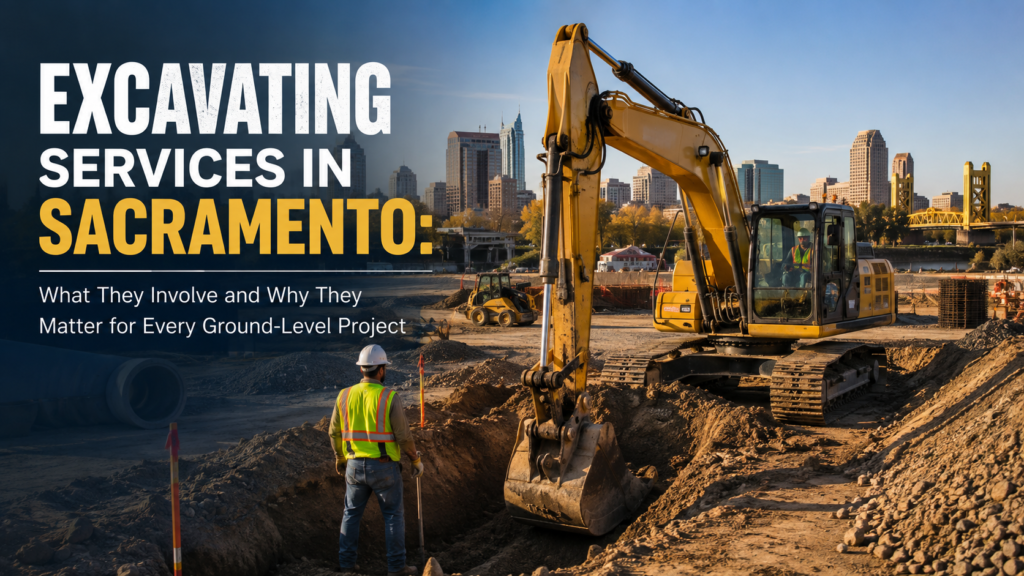
Before a foundation is poured, a utility line is installed, a pond is dug, or a driveway is graded, an excavating contractor has done the work that makes all of it possible. Excavating Service Sacramento the controlled movement, removal, and management of earth to prepare a site for its intended use are foundational to virtually every ground-level construction project in Sacramento. From the valley floor’s alluvial soils to the decomposed granite and rock formations of the foothill communities, from dense urban infill sites in Midtown to rural acreage in the Sacramento Valley, excavating contractors in the Sacramento area bring the equipment, expertise, and site-specific knowledge to prepare the ground for what comes next.
What Excavating Services Include in the Sacramento Area
Foundation excavation is among the most critical applications of excavating services. Before a residential or commercial foundation can be formed and poured, the subgrade must be excavated to the specified depth, shaped to the building footprint, and prepared to the density and condition required by the structural engineer. In Sacramento’s clay-dominated valley soils, foundation excavation must account for the soil’s expansive behavior clay that swells when wet and shrinks when dry creates differential movement that can compromise foundations not properly prepared on a suitable subgrade.
Utility trenching serves a wide range of Sacramento projects. Water supply lines, sewer laterals, gas lines, electrical conduits, stormwater drainage pipes, and telecommunications infrastructure all travel underground and require precisely excavated trenches at specified depths and widths. California law requires notification through the Underground Service Alert (USA/Dig Alert) system at least two business days before excavation begins, ensuring that existing underground utilities are located and marked before trenching starts.
Mass grading the large-scale movement of earth across a development site to establish design grades is the earthwork phase that shapes the entire topography of new developments in Sacramento’s growing suburban communities. New residential subdivisions in Elk Grove, Rancho Cordova, Lincoln, Roseville, and other growing communities require mass grading that moves thousands of cubic yards of material from cut areas to fill areas, creating the pads, streets, and drainage features on which new construction is built.
Land clearing and site preparation prepares raw parcels for development by removing trees, stumps, brush, and organic material from the building footprint. This clearing scope is often combined with excavating services into a single integrated site preparation contract, allowing the excavating contractor to move from clearing to grading to excavation in a continuous sequence that minimizes mobilization and scheduling complexity.
Drainage installation addresses one of Sacramento’s most pervasive site engineering challenges. The combination of flat terrain, clay soils, and heavy seasonal rainfall creates persistent drainage challenges across the region. French drains, retention basins, retention ponds, swales, and underground stormwater management systems all require excavating contractor installation. Sacramento’s extensive post-2017 flood mitigation work has driven significant excavating activity in drainage improvement projects throughout Harris County and the urban core.
Sacramento’s Geology and Its Effect on Excavating Work
Sacramento’s geology varies significantly across the region and directly influences how excavating work is planned and executed. The valley floor which encompasses the City of Sacramento, West Sacramento, and the suburban communities of Elk Grove, Natomas, and Rancho Cordova is underlain by deep alluvial deposits: layers of silt, clay, and sand deposited over millennia by the Sacramento and American Rivers. These valley soils are generally soft, workable, and conducive to conventional excavating methods, but the expansive clay component creates subgrade engineering requirements that experienced Sacramento contractors understand well.
Moving east into the foothills El Dorado Hills, Folsom, Cameron Park, Auburn the soil transitions from valley alluvium to decomposed granite (DG) and harder rock formations. Decomposed granite is more workable than bedrock but requires different techniques than clay excavation; it can be ripped with a bulldozer or excavated with a standard bucket in most conditions but can present stability challenges on cut slopes. True bedrock encounters in the foothill communities may require hydraulic breakers or, in some cases, controlled blasting under California Department of Industrial Relations permits.
Sacramento’s high water table in some areas particularly the low-lying areas of South Sacramento, the Natomas basin, and areas near the Sacramento and American Rivers creates dewatering requirements for deep excavations. Excavations that reach below the seasonal high water table require active dewatering to keep the excavation dry and stable enough for work. Sump pumps, wellpoints, or deep well systems are used depending on the depth and extent of the dewatering requirement.
Cal/OSHA and Safety Requirements for Sacramento Excavation
Excavation and trenching are among the most hazardous construction activities, and Cal/OSHA’s standards for excavation safety (8 CCR 1541 and 1541.1) are strictly enforced in California. Key requirements include: a competent person present at all excavations who can identify existing and predictive hazards; cave-in protection for any excavation 5 feet or deeper; utility locating and marking before excavation begins; and adequate access and egress from trenches over 4 feet deep.
Cave-in protection can be achieved through sloping, shoring with hydraulic or timber systems, or use of a trench box or shield. Sacramento’s clay soils hold trench walls reasonably well under dry conditions but can become unstable when saturated Sacramento’s wet season from November through April brings precipitation that can rapidly change trench stability conditions. Experienced Sacramento excavating contractors plan cave-in protection based on worst-case soil conditions rather than assuming dry-season stability.
Common Questions About Excavating Services in Sacramento
What is the difference between excavation and grading? Excavation refers to removing earth below the existing surface to create a specific shape, depth, or void. Grading refers to shaping the surface horizontally to achieve specified elevations and slopes. In practice, these operations are closely linked excavation generates spoil material that is then used in grading, and grading follows excavation to shape the disturbed site to design conditions.
Does excavation in Sacramento require a permit? Grading and excavation permits are required for projects that significantly alter drainage patterns or exceed certain disturbance thresholds. Sacramento County and the City of Sacramento both have grading permit requirements for construction-related earthwork. Underground utility installation typically requires permit applications to the relevant utility authority. Confirm specific permit requirements with the City of Sacramento or Sacramento County Community Development Department.